
Convoy’s Wellness Scene Was Here Long Before TikTok

A trip to Convoy can involve a shopping bag full of sheet masks, an acupuncture appointment, a communal soak, or a manicure with enough rhinestones to warrant its own spotlight. Across the district’s skincare shops, treatment rooms, spas, and nail studios, taking care of yourself takes several forms.
Some of those rituals have found new audiences online. Facial gua sha has had its TikTok moment, and Korean skincare routines circulate through social media feeds. But the businesses offering beauty and wellness services here have different stories: family knowledge passed down, a livelihood built after displacement, or a gathering place where caring for yourself includes spending time with others.
At Seoul Glow Lab, that means helping customers make sense of skincare. At Vinh Hoa Hong, it means continuing a family’s Chinese herbal medicine practice. At Yu Spa, it’s putting down your phone and settling into a communal bath. Together with the district’s nail studios, these businesses offer another way to explore Convoy—and meet the people behind its approaches to personal care.
Riding the Hallyu: K-Beauty at Seoul Glow Lab
Remember the 2012 version of you? The one probably cutting off lower-body circulation with skinny jeans, wearing thick-rimmed glasses, and galloping to “Gangnam Style” with zero clue what the words meant?
Psy’s hit represented a Korean cultural wave—called “Hallyu”—that had been building for decades. In 1993, an American movie taught South Korean officials about using culture as an export. The profits from Jurassic Park were generally equivalent to those from 1.5 million exported Hyundais. The rub: At the time, South Korea was exporting half that many vehicles annually. Cars couldn’t be the only export; culture was commodified, too.
Following the end of military censorship and the 1997 Asian financial crisis, South Korea increased its cultural budget nearly sixfold from 16.8 billion Korean won in 1998 to 100 billion Korean won in 1999. (That’s about a $14 million to $88 million jump in USD.) That year, the country passed the Framework Act on the Promotion of Cultural Industries to fund movies, television, music, and games.
Global phenomena followed: BTS, Blackpink, Parasite (the first non-English Best Picture Oscar winner), and Squid Game. As Korean media swept global screens, American viewers took notice of the stars’ dewy, glass-like complexions.
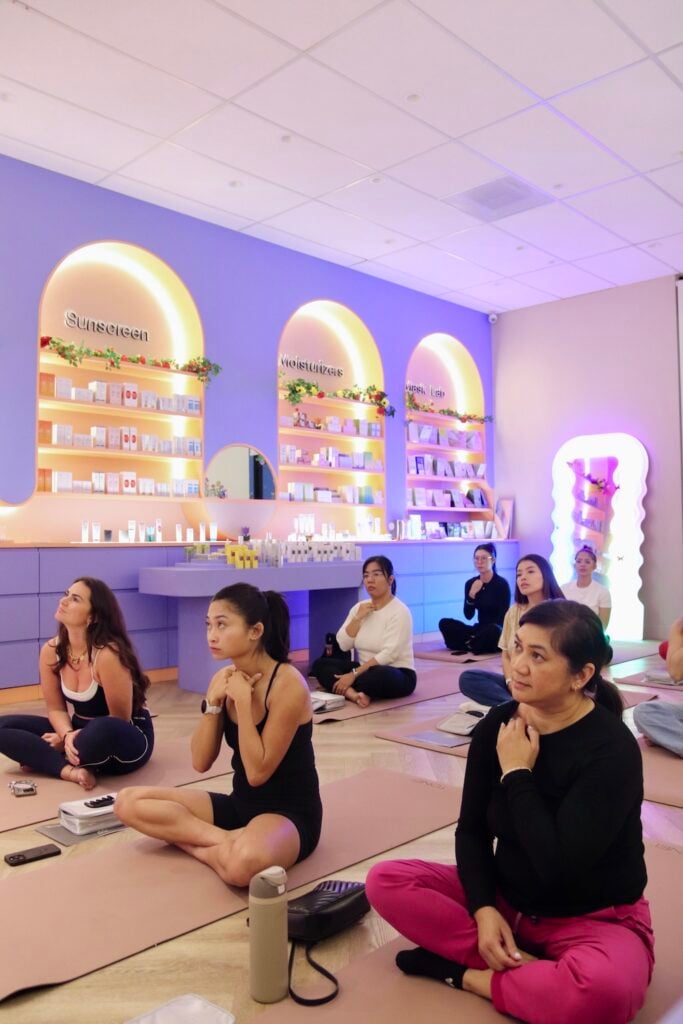
In the first half of 2015, Korea exported $52 million worth of beauty products to the US (a 60 percent jump from the previous year), and the mainstream usage of K-beauty has only grown since then. Convoy Street is a Korean beauty anchor in San Diego. In Seoul Glow Lab, soft lavender-blue and peach-colored lit arches display essences, sheet masks, sunscreen, serums, and ampoules.
For those prone to decision paralysis, the options might feel overwhelming. Owner Katie Hernandez knows that feeling all too well, but skincare education is the ethos behind her store.
“The goal has always been to make skincare feel approachable and personal,” says Hernandez. “Whether someone knows everything about skincare or absolutely nothing, I want them to feel comfortable asking questions, touching things, learning and figuring out what actually makes sense for their skin.”
Part of the Seoul Glow Lab education includes an AI skin analysis that helps guide skincare routines based on personal concerns and goals. Sabrina Kim—the in-house esthetician and founder of the Soulcare Standard wellness studio based in Seoul Glow Lab—uses a “barrier first” approach focused on long-term protection. For her, “Korean skincare” almost feels redundant; it’s family wisdom passed down through generations. Growing up, she says, it was just skincare. Today, ingredients like mugwort, centella, green tea, and fermented rice combine traditional heritage with modern cosmetic chemistry.
“My mission is to expand self-care into collective care,” Kim says. “Wellness isn’t a luxury; it’s a birthright.”
Needles, Anyone? Traditional Chinese Medicine at Vinh Hoa Hong
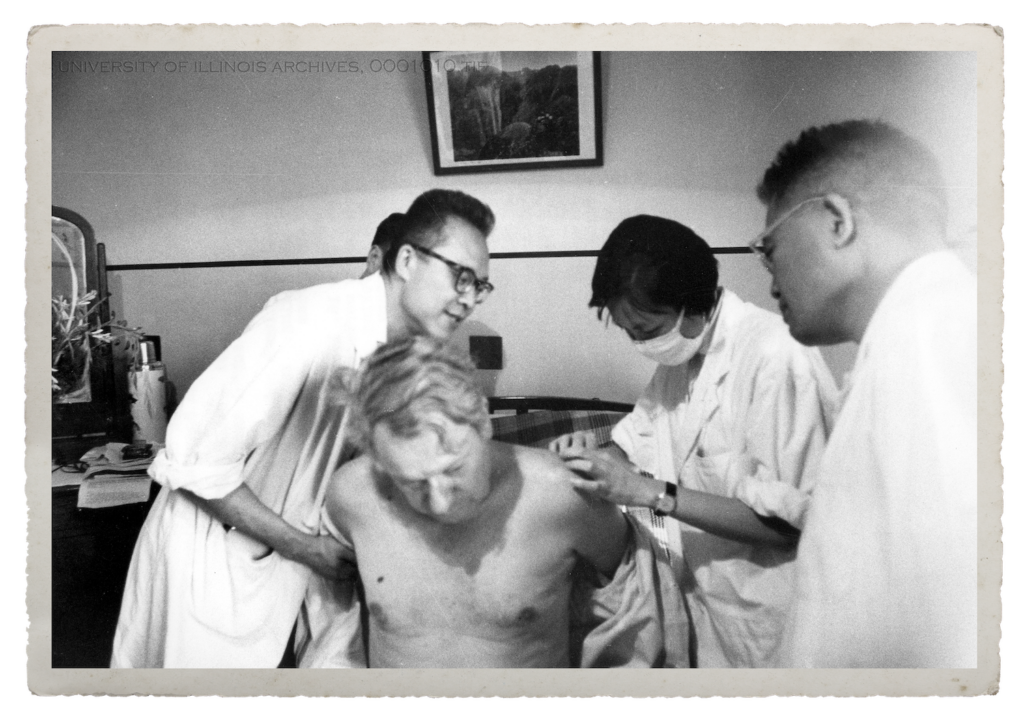
It all started with an appendix, or rather, an obituary for one. In 1971, New York Times journalist James Reston traveled to China ahead of President Nixon’s 1972 visit. After undergoing an appendectomy in Beijing, Reston experienced lingering stomach discomfort. An acupuncturist inserted needles near his elbow and knees and performed moxibustion—a Traditional Chinese Medicine (TCM) therapy consisting of burning dried mugwort on the body—the abdomen, in Reston’s case. Within an hour, the discomfort disappeared.
His experience written as a New York Times article—along with growing distrust in Western medicine during the 1970s (in part fueled by scandals like the Tuskegee Syphilis Study exposé) and the legalization of acupuncture and TCM practices in California in 1975—helped set off an American fascination with Eastern modalities in medicine, even though these practices had been quietly thriving within Chinese immigrant communities since the mid-19th century.
In 1994, Vinh Hoa and his family (Vietnam war refugees) opened Vinh Hoa Hong, a small Chinese herbal shop located in the same plaza as Jasmine Seafood Restaurant. His eight children took turns helping around the shop and translating to customers. After years in business, the family entertained the idea of selling it, but the youngest daughter wanted to keep the legacy going.
“I consider myself a reasonably patient person,” says Dr. Marlene Vong, that daughter who’s now the owner of Vinh Hoa Hong. “But when it comes to my patient care, I am very impatient. If I can have you feeling better now, we are going to do it.” She says many of her patients come to her as a last resort—discouraged after many years of Western medical practitioners telling them that pain is something they’ll just have to live with.
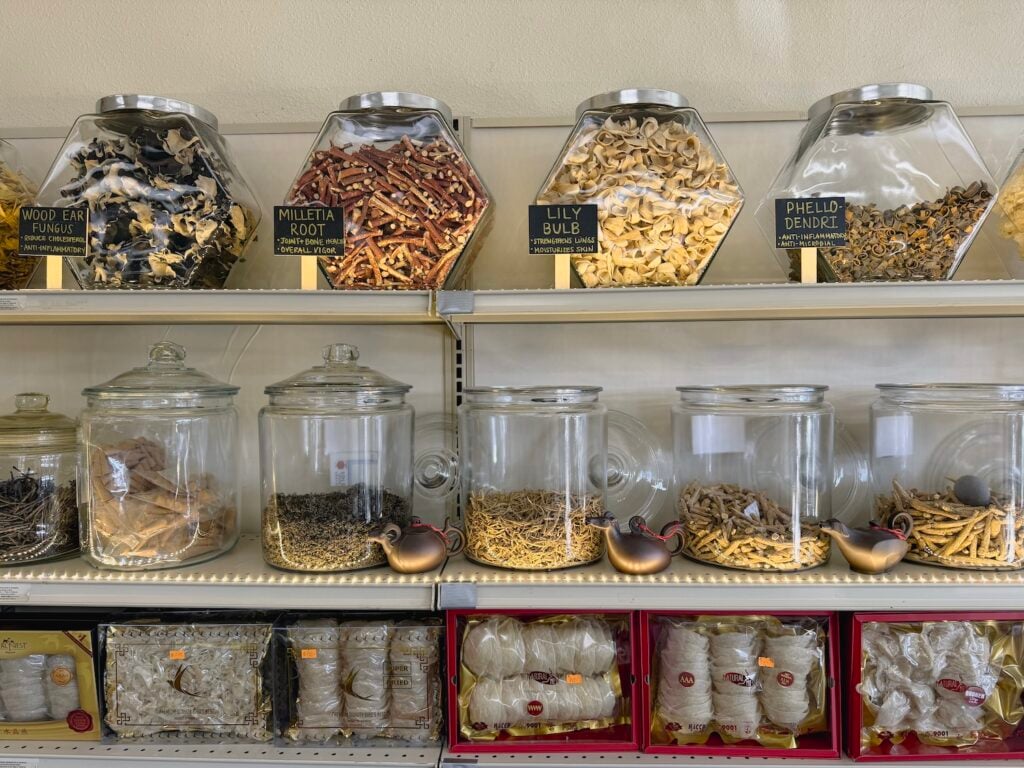
TCM, in general, encompasses herbal medicine, acupuncture, acupressure, gua sha, and moxibustion, unique treatments for each body. Hair-thin needles and massage stimulate the body, while Chinese herbs like goji berry, licorice root, ginger, and dang gui tonify blood, heal the liver, and aid digestion. TCM treatments focus on supporting existing physiological responses. The ultimate goal is balancing the yin and yang—the physical and nonphysical self. At Vinh Hoa Hong, shelves hold lily bulbs (moisturizes skin and lungs), milletia root (boosts joint and bone health), and wood-ear fungus (reduces cholesterol).
“People are looking outward instead of inward,” she says. “Logic will only get you so far, but it’s your intuition that will take you further. So you have to start learning to listen to your intuition, start listening to your body, and try to understand what your body’s telling you.”
Communal Cleansing at Yu Spa
From Roman thermae and Turkish hammams to Japanese sentōs, Chinese zaotáng, and Korean jjimjilbang, communities have gathered for thousands of years both for basic hygiene and collective relaxation.
In the US, bathhouses served as sanctuaries for Asian immigrants to speak their native languages, share traditional food, and maintain familiar cultural practices. Yu Spa on Convoy Street does just that. At check-in, guests receive a uniform for co-ed common areas. Inside the sex-separated wet areas, guests move nude through soaking pools, cold plunges, steam rooms, and dry saunas. Bathhouse culture strips away visual symbols of status—clothing, jewelry, accessories—leaving guests to connect without social signaling.
If you’re not used to it, baring it all can be intimidating. But for Yu Spa customers like Haley Castelvecchi, it can also be liberating. “We get so used to seeing a certain look or body type online that I think we forget how diverse people actually are in real life,” she says over email. “Being in that environment is really freeing because it reminds you that there’s nothing inherently wrong with you or the way you look.”
In a culture where bodies are often filtered, posed, tucked in, sucked in, and picked apart, there’s something radical about a room where you’re simply allowed to exist. There’s a vulnerability in sharing that space—sweating next to a stranger and letting your guard down—but there’s community in it too. Taking care of yourself doesn’t always mean doing it alone.
As Resilient as Acrylics: Convoy’s Nail Studios
A Hollywood actress’s perfect manicure was the starting point to a cultural identity. After the Fall of Saigon in 1975, thousands of Vietnamese refugees resettled in the US, many of them passing through Camp Pendleton. Tippi Hedren, the star of Alfred Hitchcock’s film The Birds, was volunteering at the camp and became close to a group of Vietnamese women who loved her nails.
Hedren brought in her personal manicurist, Dusty Coots, to train a group of 20 Vietnamese women. The trade required low startup capital and minimal English proficiency, creating a channel of opportunity in the US. Today, the California Healthy Nail Salon Collaborative estimates that 80 percent of California nail salons are Vietnamese-American owned.
“I loved these women so much that I wanted something good to happen for them after losing literally everything,” Hedren told the BBC in 2015. “Some of them lost their entire family and everything they had in Vietnam: their homes; their jobs; their friends—everything was gone. They lost even their own country.”
Nail polish itself originates from China, 3000 BC. Early forms were made from beeswax, egg whites, gelatin, vegetable dyes, and gum arabic—also worn to indicate high class status. Modern manicures have since evolved into wearable art featuring 3D designs, magnetic effects, and intricate brushwork.
A 2023 study published in Frontiers in Psychology showed that professional nail care boosts positive mood and relaxation. Convoy’s studios have their own aesthetic specialties, all in the name of self-care and mood-boosting: Asie Salon & Spa specializes in maximalist rhinestone sets; CA Japanese Nail focuses on soft gel gradients and fine-line artwork; and AO Nails-Convoy provides Gel-X extensions and custom designs.
None of these findings—or self-care methods—are particularly new. Families, immigrant communities, and neighborhood businesses brought these practices to Convoy. The seeds they planted decades ago continue to grow and define the way in which all San Diegans experience wellness.
The post Convoy’s Wellness Scene Was Here Long Before TikTok appeared first on San Diego Magazine.
Categories
Recent Posts